A tree of ideas
Follow the branches to meet contributors and the questions they explored.
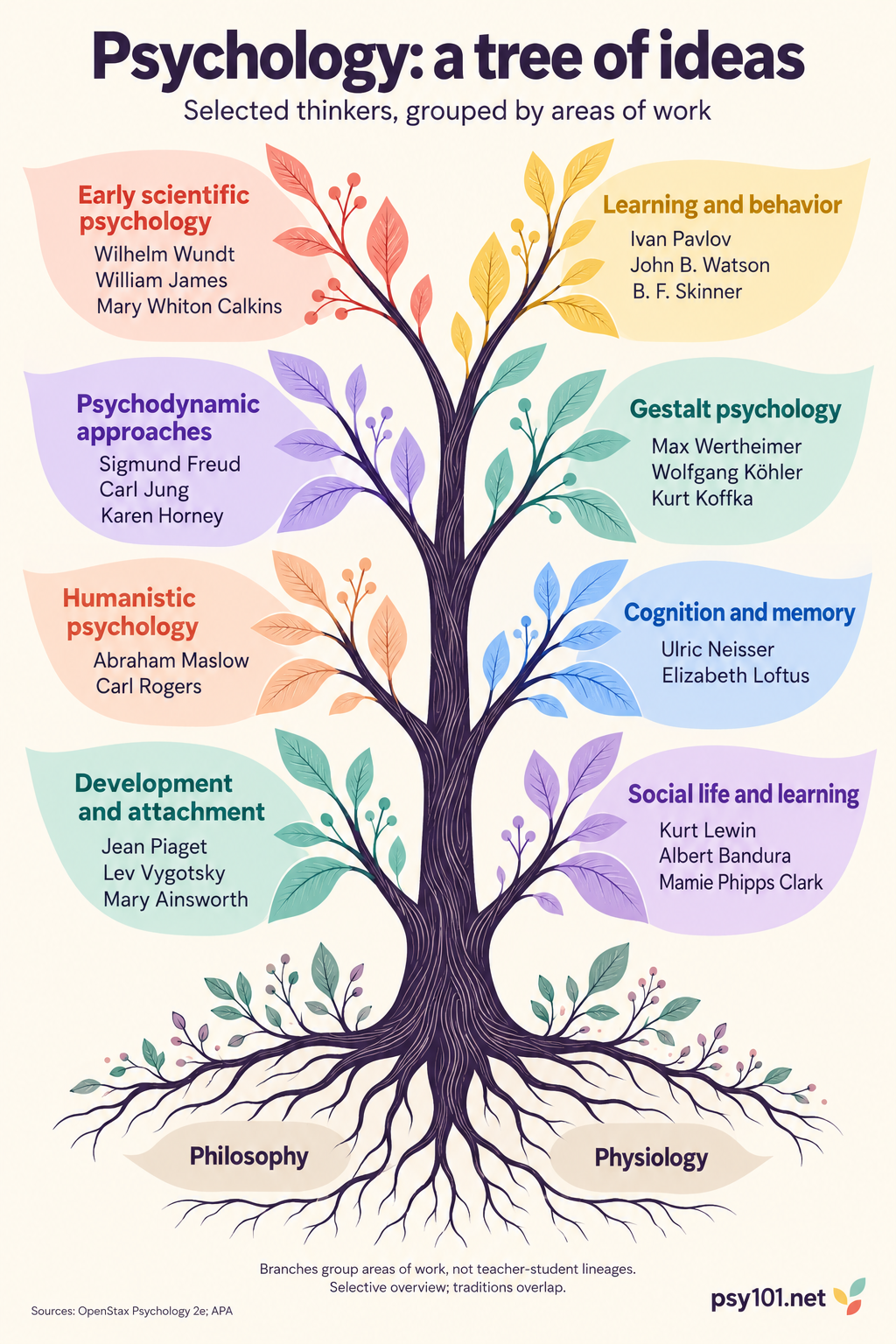
The picture in words
- Early scientific psychology
- Wilhelm Wundt, William James, Mary Whiton Calkins
- Learning and behavior
- Ivan Pavlov, John B. Watson, B. F. Skinner
- Psychodynamic approaches
- Sigmund Freud, Carl Jung, Karen Horney
- Gestalt psychology
- Max Wertheimer, Wolfgang Köhler, Kurt Koffka
- Humanistic psychology
- Abraham Maslow, Carl Rogers
- Cognition and memory
- Ulric Neisser, Elizabeth Loftus
- Development and attachment
- Jean Piaget, Lev Vygotsky, Mary Ainsworth
- Social life and learning
- Kurt Lewin, Albert Bandura, Mamie Phipps Clark
Philosophy and physiology appear at the roots as two historical foundations.
Reading the illustration
The branches organize selected contributions by area of work. Many ideas and careers connect several branches. This selection emphasizes European and North American traditions.
Try a question
How might one contributor connect several branches of this tree?
Show the explanation
A researcher can investigate learning, development and social relationships within the same career. The branches give you several routes into that work.
Read the sources
- Spielman, R. M., Jenkins, W. J., & Lovett, M. D. (2020). Psychology 2e. OpenStax. https://openstax.org/books/psychology-2e/pages/1-2-history-of-psychologySelected historical overview passages inspected
- Spielman, R. M., Jenkins, W. J., & Lovett, M. D. (2020). Psychology 2e. OpenStax. https://openstax.org/books/psychology-2e/pages/1-3-contemporary-psychologySelected field descriptions inspected
- Spielman, R. M., Jenkins, W. J., & Lovett, M. D. (2020). Psychology 2e. OpenStax. https://openstax.org/books/psychology-2e/pages/11-3-neo-freudians-adler-erikson-jung-and-horneySelected Jung and Horney passages were inspected for their historical placement in psychodynamic approaches. Specific theories are presented as their proposals.
- Spielman, R. M., Jenkins, W. J., & Lovett, M. D. (2020). Psychology 2e. OpenStax. https://openstax.org/books/psychology-2e/pages/9-2-lifespan-theoriesThe Vygotsky sociocultural subsection was inspected for the role of social, cultural and historical context in development.
- Spielman, R. M., Jenkins, W. J., & Lovett, M. D. (2020). Psychology 2e. OpenStax. https://openstax.org/books/psychology-2e/pages/9-3-stages-of-developmentThe attachment subsection was inspected for Ainsworth’s Strange Situation research and the secure-base idea in caregiver-child relationships.
- Spielman, R. M., Jenkins, W. J., & Lovett, M. D. (2020). Psychology 2e. OpenStax. https://openstax.org/books/psychology-2e/pages/6-4-observational-learning-modelingSelected Bandura passages were inspected for observational learning, modeling and cognitive processes in learning.
- University of michigan research center for group dynamics: History. (n.d.). https://rcgd.isr.umich.edu/leadership-mission/history/The founding section was inspected for Lewin’s group dynamics research and attention to the relationship between people and their social environments.
- Emory news: Ulric neisser, cognitive psychology pioneer, dies. (n.d.). https://news.emory.edu/stories/2012/03/ulric-neisser-cognitive-psychology-pioneer-diesThe institutional obituary body was inspected for Neisser’s work in cognition, memory and perception, including his 1967 book Cognitive Psychology.