Sampling and assignment
Follow participant selection and allocation as two steps in a study.
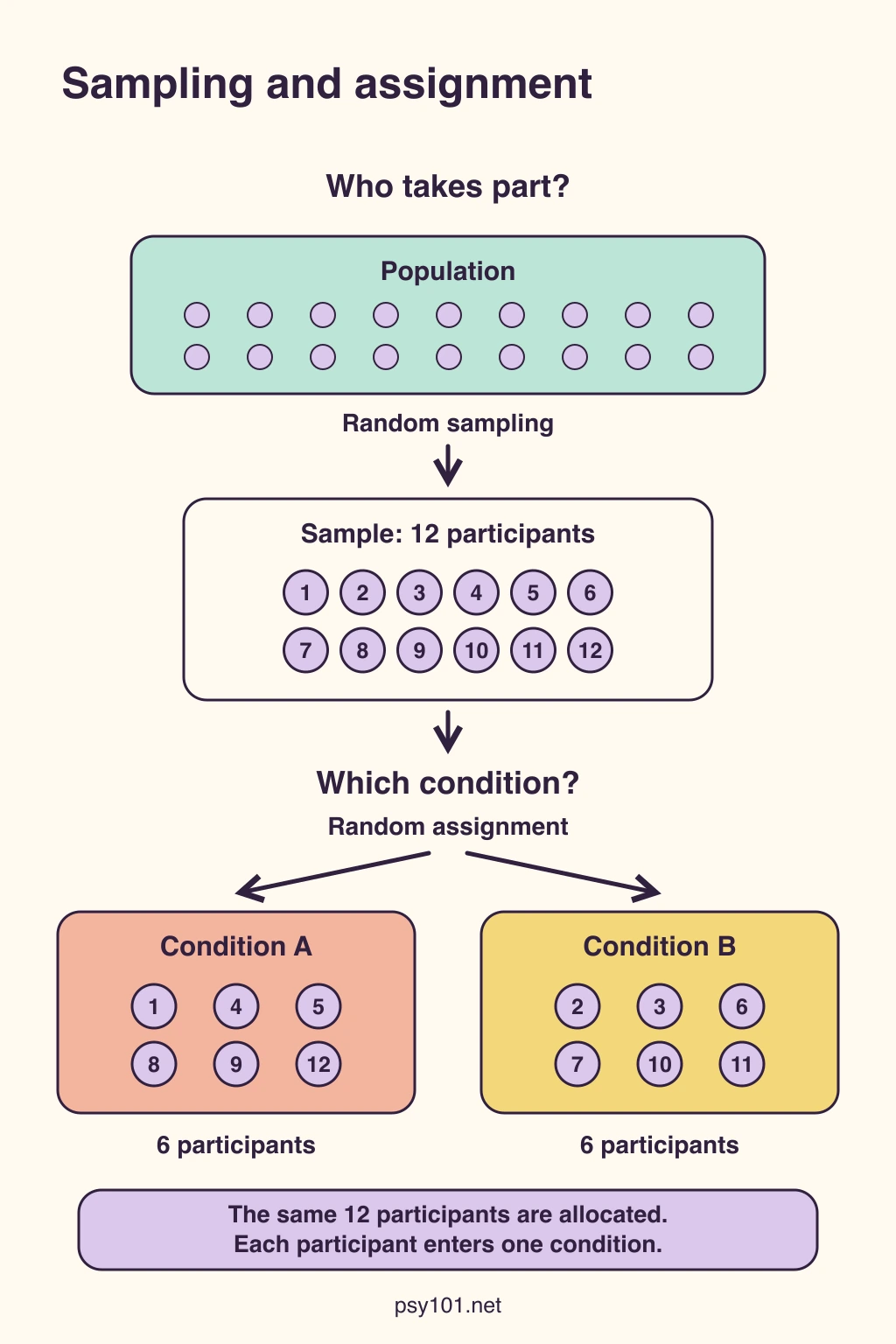
The picture in words
- Random sampling
- Select 12 participants from a larger population.
- Random assignment
- Allocate these same 12 participants to conditions by chance.
- Condition A
- Participants 1, 4, 5, 8, 9 and 12 enter condition A.
- Condition B
- Participants 2, 3, 6, 7, 10 and 11 enter condition B.
Reading the illustration
Follow the participant numbers from the sample into the two conditions. Each number appears in exactly one condition. Equal group sizes illustrate this allocation; random assignment can use different allocation procedures.
Try a question
Which step helps create a fair comparison between study conditions?
Show the explanation
Random assignment distributes participants across conditions by chance. Sampling addresses how the participants relate to the population of interest.
Read the sources
- Spielman, R. M., Jenkins, W. J., & Lovett, M. D. (2020). Psychology 2e. OpenStax. https://openstax.org/books/psychology-2e/pages/2-3-analyzing-findingsSelected introductory passages inspected