Consistency and useful measurement
Ask whether a measure is consistent and supports its intended interpretation.
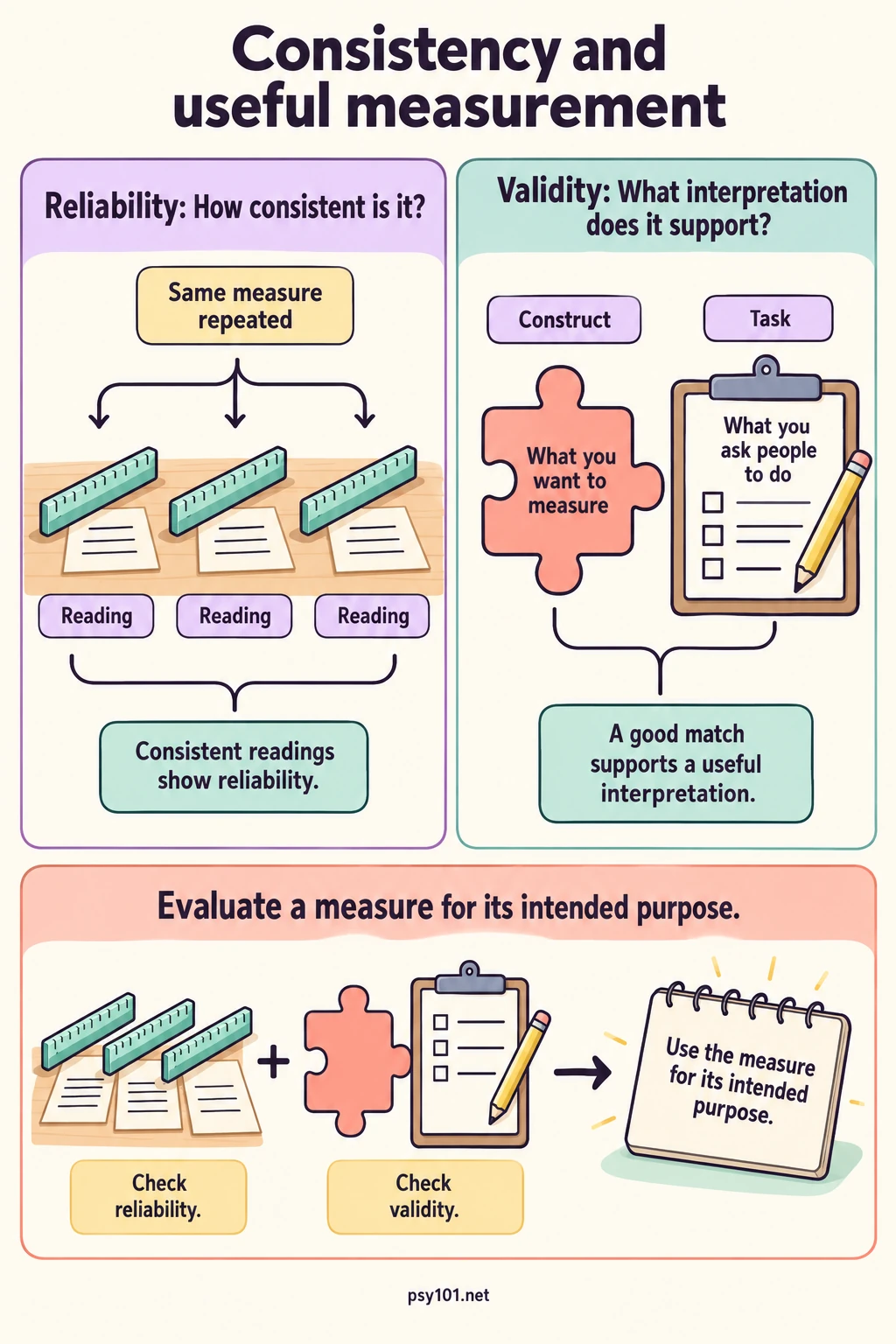
The picture in words
- Reliability
- Consistency across relevant repetitions or items.
- Validity
- Evidence for the intended interpretation and use.
- Purpose
- A measure is evaluated for a particular task.
Reading the illustration
Treat the two panels as separate questions: consistency across relevant repetitions, and evidence for a particular interpretation and use.
Try a question
Why would repeated agreement alone leave a question about a measure’s usefulness?
Show the explanation
Consistency helps establish reliability. Researchers also examine whether the measure represents the intended construct for the proposed use.
Read the sources
- AERA, APA and NCME: Standards for educational and psychological testing (2014). (n.d.). https://www.testingstandards.net/uploads/7/6/6/4/76643089/standards_2014edition.pdfSelected PDF extracted text: Validity opening printed p11; Standards1.0-1.2 printed p23; reliability opening printed p33 (PDF20,32,42).